
Presence, Attention and Discernment
An exploration into Presence, Attention and Discernment putting into relationship with Carol Sanfords framework of Capacity, Culture and Consciousness. This piece works out the wholes and joins them.

What is this journey we’re on? Really what are the different positions we can inhabit? I spend a lot of time thinking about it, twisting and turning it to allow us to lean in deeper. The purpose is to be able to find useful simple stances that I (perhaps we) can shift between to find movement. Inspired by Carol Sanford and her book Indirect work (brilliant book!) these stances seems to come in three’s because there is freedom in “working with three’s in a polar world” as she puts it.
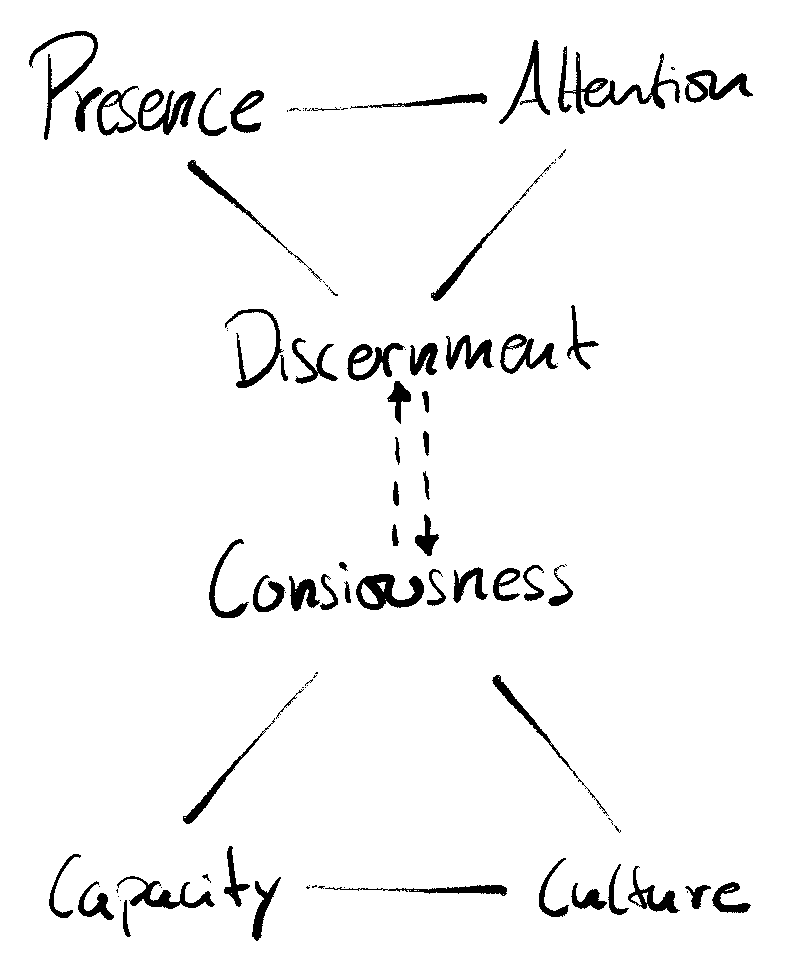
This will be an exploration and deepening into a triad that has kept demanding my attention lately. The one between presence, attention and discernment. I imagine attention and presence as the base of the triangle and discernment there at the bottom. The utility of the division into these three wholes are that it becomes a prism through which we can look at our capabilities (personal inclinations and focus areas), culture (collective inclinations and focus areas) and consciousness (our implicit order that drives our actions and our ability to disrupt [non-generative] patterns). To find out more about this three phase circle check Indirect work (C. Sanford). I will keep weaving between them in this article.
The project I find myself on is one of liberation of individuals, unsticking our culture and hopefully be(coming) an agent in the unfolding shift in consciousness that I perceive to be happening. This exploration is part is a snapshot of that larger movement.

Presence - non-storied experience
This seems to be on our collective mind at the moment. Or actually there seems to be a systematic ongoing movement away from our cultivation of this ability. Be it the popularisation and instrumentalisation of traditions like mindfulness or equanimity or be it the constant model drawing and boxing in of our current moment through different lenses or even just narrating our internal emotional landscapes moment to moment. Constantly explaining through words and static concepts separate ourselves from our experience. The Presence. It makes us forget the whole(s).
The mechanistic paradigm runs so deep that we seem unable to trust that things are happening unless we are explicitly expressing them. These things we are dealing in when we deal with presence are not abstract. This is something we have to once and for all agree on. They can however be subtle. Very subtle even. It’s like that scene in Gladiator (the movie) where Russel Crowes character Maximus leans in towards the dying emperor: “There was a dream once Maximus, that was Rome. It was so fragile that you could only whisper it or it would disappear. Let us whisper now, together Maximus.” Let’s discover that whisper. Let’s talk about the subtle.
And the very subtle. That which borders on the esoteric.
It’s that precision as you are meditating where you are in perfect balance. Where the spine seems to carry itself and you can be alert and completely relaxed. Not going anywhere just available. In your minimal, dense, black-hole like focus you are boundless, dissolved in the whole. Everything is you since you are no(-)thing.
It’s that perfect balance hurtling yourself down the mountain. In complete unity with your skis. Perfectly balanced in accordance with the snow conditions and your equipment. There is no effort required you are aware of nothing yet perfectly aware of the whole.
When you describe it later. Make sense of it - you cannot. For no reason other than that it did not appear at the level of reason. It is perfectly reasonable that you cannot make sense of it applying reason.
Presence is not a story. It is what it is. The isness, interbeingness or whatever one might need to label it as. I recognise my presence as an expansive feeling of complete, effortless stillness. That is the stance from which I will be able to move anywhere yet need to move nowhere. And I could theoretically be there forever. It is non-storied experience. It’s pre-interpretation. It is a capacity to deal in wholes. Prior to labels or categories. Prio to understanding but centred in profound knowing. Right brain processing if you ask Iain McGilchrist.
Full presence is a foundation from which I can access my full potential. It is a state of deep service without need. Yet with full access to my attention should I need it to take the next step.

Attention
Everything is constantly trying to grab our attention. I’m much more of a novice in working with my attention in a sustained directed manner. I seem to always get it wrong. In the language of the pundits i.e. it seems I’m not able to manifest or call in, rather I keep discovering what I needed the entire time, right here in front of me. Particularly since I began to consciously lean into my intuition. Or perhaps since I began following my attention. Accepting that I do things without knowing exactly why other than that it feels right.
I’m saying that as something of a disclaimer. I don’t know how proficient I am in this domain. I see others that have a much finer tuned sense for cognitive attention than I. Yet I feel like I now something about it.
Attention seems to be the motor in this triangle we’re working through. The attention is what drives movement. I feel it when I’m sitting as a (usually) minuscule tilt forward of the head, or a tensing of the jaws. These are physical tells that I’ve left the breath and is caught up in figuring something out.
What’s been generative to me is to look at how it is that I pay attention. What seems to be driving it? Is it curiosity (good sign) or am I trying to avoid something or get something to happen (bad sign)? Does the attention result me to tense up? Lean in with effort? Push? Those are the ways that I used to be looking for to affirm that I was moving. Effort. It feels good to me to push hard. Yet I’m learning that feeling good in that effortful way is not necessarily connected to real attention nor is it very connected to life. The big, fireworky type events are in some sense easy to figure out but of less consequence. Fireworks appear downstream of sparks. Effort or suffering are such fireworks in my book.
I think about it like this. When I’m at the centre of my being, almost fully at rest, each movement of the wind will be very subtle and for me to feel into it I need to venture in small ways from my presence, care-fully engaging my attention. This is small stuff, yet in my experience it seems like these are the differences that really make a difference as they propagate through my(-)self. It is the stuff G. Bateson might be pointing to with that invitation to pay attention to difference that make a difference and the stuff that Sanford points to with her term Indirect work. A small movement at the center of a wheel will make it travel far in the periphery.
On the other hand when I’m far out in the wheel, the movement is more obvious. The wind will be more obvious when I’m running than when walking. Fireworks are more obvious than a glowing ember escaping a small fire. Sacrificing myself, doing something I don’t like ‘for’ my wife is more obvious than just being around, attentive to her needs. Yet my experience is that the attention yields more. Activities further out in the wheel seem less consequential yet commandeer my attention through their obviousness. Letting that go and paying attention feels different. More aligned with values perhaps.
The skill at the core of this seems to be cultivating the ability to notice the subtle. The real shifts. Is not obvious but potentially life changing. And it takes work. Consistent work. Like Carl Newport points out in his book Deep Work. We assume that we all have an innate ability to pay attention. It’s no longer so. The torrent of impressions in the firework category dilutes our capacity to pay attention altogether. It’s no longer that we missed something, its rather that we never saw it at all.
This is the trick. Lacking this capacity deeply influences our culture towards one of more explicitness, making it more cartesian, which in turn shapes our consciousness - our belief about how the world works. When things shifts we keep looking at the consequences of the shifts, missing the shifts themselves. At the time of the emergence most of the change has been happening for a long time already. Most of it is already determined. At that stage we just have to go with it. We are victims of it. Efficient agents have the capacity to sense the fulcrums, the pivot points, the shifts. Those nodes where energy is bound and where subtle actions can generate large consequences.
To be able to do that work we need to constantly practice our attention. Fine tuning it to the more subtle movements and building a capacity to track how they have propagated through the system after the fact. To do that what we need actually is another whole - the one of discernment.

Discernment
If Presence was somewhat familiar, Attention is an area of growth, true Discernment has been elusive for a large part of my life. Only lately have I come to realise that whatever I thought it was, wasn’t it at all. Like attention and presence, it’s not effortful. Discernment feels to me like resonance or remembering. It is discovering the most obvious thing right there in front of me.
I’ve been using the analogy of the love song. When I’m sense-making it’s those platitudes that I refrain from saying because they are so obvious. The words don’t make sense, it cannot be that simple. Yet the distinction between simple and easy is an important one to keep in mind here. What is simple is not necessarily easy and vice versa. What is obvious is usually not what we end up doing. We tend to have a whole array of excuses to get to do something else. Something that does not require us to change.
Back to the love song. You know when you’re heart broken and you hear a love song. Every word seems to hold deep truth just for you in a way that you cannot understand. Return to that same song a little later, with a less broken heart and you’ll feel like it’s just mostly silly. The judgement, desire or longing to be special or different or more sophisticated is so strong that we resist the obvious.
As a coach I’ve felt that. So have I in my own development. “No way! If it was that easy why have I been doing it in this hard way all along?”. The resistance touches upon the economic term ‘sunk cost fallacy’: it’s where we’ve invested so much already in something that isn’t working that we ‘might as well’ keep investing in it. The convoluted, entangled way has become an in-itself, a self sustaining system. Something I rather keep feeding more energy into than use a little energy to break free from. Without a method for discernment, it’s likelier that I remain stuck than break free.
Discernment is in my experience deeply uncomfortable. It is ways to be and act that have consequences. That discernment creates a knowing that almost forces me to change. And as one thing changes everything becomes different. It’s effortful, not because it requires a lot of effort but because it brings us into close contact with our identitymaking fears. The discernment is in a way a step towards knowing. And once we have known it’s hard to unknow.
If we weren’t ready to change in the first place that knowing will weigh on us. Making us erect barriers in places, keeping us from change. Making life more effortful, perhaps telling a story that the effort is part of us doing better. Like for instance introducing more time consuming routines, self development or healing practices so we won’t have time or energy for the actual change itself. Perhaps one such protection is the pursuit of understanding? As a teacher recently told me “understanding stands in the way of knowing”. I just didn’t imagine that it was so literally so.
This is what I meant by discernment feeling different than what I imagined. This too is a move towards relaxation, towards removing obstacles and things I’m doing. Working with the simple and obvious, trying to be just that. I discern to create more space for relaxation and rest. The discernment itself is deeply uncomfortable, it means leaning into and being with my tension. Yet it’s just that. Being with it. Not trying to fix anything. If I stay with it (discern) I’ll naturally fall into stillness (presence) or sense a direction that pulls me (attention).

Dancing through the framework
Here’s the pivot point. I’m proposing that if we want to cultivate an agentic relationship to our lives we would ideally either be attending (with a direction) or in presence (without a direction). If we’re not, we’d discerning (staying with it). You might notice that there is very little room for story. And that this can happen cognitively or not. Consciously or not.
In my experience the trick is not so much that we cannot do it (although doing it for sustained periods of time seems to require practice) it is that we’re a little confused about what ‘it’ is. None of the nodes in this triangle I’m proposing needs to entail any expenditure of energy. It will at worst be a net zero in energy. A good indication of dancing in this framework is sense of ease and rest. The main capacity is being with disease. Staying (discerning) and moving closer (attending) to it until we’re able to be at ease (presence) with it.
It doesn’t mean that we won’t sweat or get tired from the dance but the nature of the sweat and the nature of the tired is of a different type altogether than the type of sweat and effort I connect to ‘hard work’. The kind that is measured in suffering and depletion rather than relaxation and repletion. Rather if you’re doing it right as you grow more proficient your stamina will increase, you’ll feel more alive and the type of tired you’ll feel is simply different.
These nodes I propose could involve the cognitive, yet they do not have to. This process can also happen outside of understanding. Actually that is probably where it starts for most of us. And as we already established, does not mean that its outside of knowing. It could also happen inside of it. Sometimes I find that staying with the trouble, in the disease takes some effort. Looking forward to making sense of the resistance once on the other side has been nourishing, a carrot to look forward to. To get to craft a story I can tell about what happened. Yet that step is not necessary.
For me my deepest transformations so far, where attention guided me to deeper presence, has been where my discernment advised against sense making too quickly. Just because of the ’sunk cost’-like resistance I described above. I noticed that my sense making ended up feeling banal. That banality started forming a distance between myself and the felt profound experience I had just been through. Like I was containing it or directing it in some manner. I noticed that whatever I had discovered seemed to affect large parts of my identities (as can be the case when dealing with e.g. childhood trauma). If I would have put words to it I would have picked up on the stories that reinforced certain identities at the expense of others. So I refrained. That openness on my behalf let the process unfold for much longer than expected.
To relate it to my headline. Sometimes it just doesn’t make sense to stop dancing just because the song ends. Even if the club closes, who’s to say you can’t keep dancing your way out of the club, getting your jacket, returning home with the shards of yourself still finding its way through the unfolding? If you take seriously the invitation to stay with the trouble and in that staying curious to the nature of the trouble, dealing with it as an uncontainable whole (rather than a part of something). Letting the trouble, or insight, make its rounds through the presence - attention - discernment triangle, checking in with it consciously every now and then to see where it seems to be going. What if that type of restful, playful interacting with out trouble is exactly what healing is about? Then what would become possible?
Coda.
We explored presence, attention and discernment as three sides of a prism that we can use looking at the whole. The three sides put us in different stances. With slightly different orientations. These are subtle and they require our capacity. Presence is omnipresent, attention is a subtle pulling inviting us to move and discernment invites us to stay with it (usually the trouble).
If we cultivate a capacity of being through this actively restful, relaxed or playful stance that allows us to dance through the triangle. Or actually more correctly put that allows our trouble to dance trough the triangle so we can pick up the resonance and the remembering emerging from it’s (the trouble’s) dance. That holds the potential to transform culture, which in turn transforms consciousness. Each step of the transformation changes the potential of all the other steps so this is a continuous, simultaneous process. Conscious, subconscious or unconscious. At least that’s what I’m proposing.
I’ve also tried to make the argument why I believe that rest and repleason are good heuristics by which we can evaluate the process by. Effort and sustained suffering will not be sustainable, nor are they signs that you are working hard. Those are facets of your programming. Instead a self-reinforcing process that is possible to sustain is what we are looking for. This needs to be playful or restful or both since there is no end to the trouble that we need to stay with. I like the analogy of the dancing with the presence, attention and discernment until the day breaks, long after the music ended and in our sweat and fatigue we’ll have found the embers for transformation. Transformation that will spark into flame when there is sufficient amounts of fuel or at the very least creating a new place, a place form where we can begin again.
Would you like to work with me through this framework on something you’re going through? Reach out at hello[at]amitpaul.com. I coach, advice and consult. If you want more of my thinking consider subscribing and check out the World of Wisdom Podcast wherever you listen to podcasts.