
Excerpt 3: Ripping up the maps. On lostness, attention and going to the edge of the wild
In this 3rd excerpt we’re speaking of what constitutes our world. The socio-somatic-psycho-emotional filters we carry inside us through which we construct our world. This is a meditation on maps.

By Amit Paul & Eric Lichtman
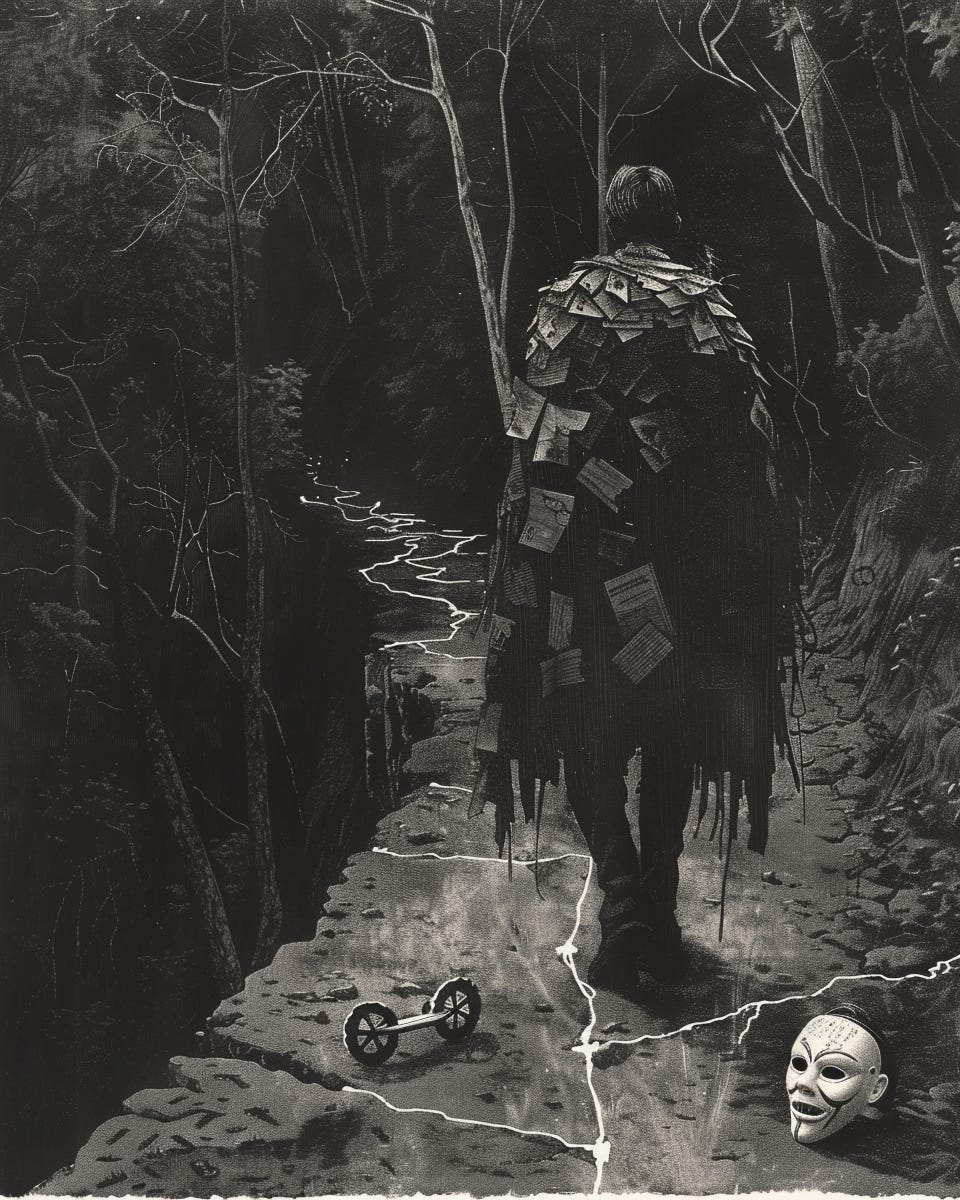
1. Why maps? What maps may also be, and an invitation to let go!
Amit Paul
This third piece is about maps. Not the literal, physical maps. Instead, we’re inviting a perspective where we are looking at the filters we have between self and world. We work with four aspects of these maps. These four ingredients to map-making are not trivial matters. They’re complex. They have to do with discovering and applying much of what constructs and constitutes the self interacting with the world. We’ll present them here, upfront. See if you can track them through the stories below, if you can track them in your life.
Self and outer world: relationship to the other. We interact with the perceived outer through our sensory equipment. What we can sense is interpreted by our body-minds, translated into meaning. This is a process that has little to do with how the world is and much to do with how we are able to feel into it. An awareness of the inherent subjectivity shifts our relationship with the world.
Self and inner world: relationship to self. We interact with our inner world of thought in ways that seem stable and coherent. Often forgetting that memory as well as story and identity - all maps in this writing - are adaptive traits. They are made based on what we are trying to achieve, not based on objective fact. Sensation comes before emotion; emotions are bundles of sensations that we label and then organize to mean something. Ability to drop such labels and stay with the subtle shifts of sensation, the metabolic shifts, this changes our relationship with the world.
Constructed self: relationship to identity. We hold many identities and the most active of these identities actively influence what we are able to prioritise. What you will care about as a professional or as a parent or friend is quite different. What language, posture and actions you have access to or that seem possible shifts drastically as you identity shifts. Being aware of these traits and restrictions, awareness of which identities that are most active and vocal at a given moment changes our relationship to the world.
The relationship to our culture: relationship to the relational field. The “when” in which we live. We are constantly participating in collective fields, partly shaped by our culture. The water in which we swim. This determines to a large degree what the good, true and the beautiful is. It orients and restricts us, sometimes clearly and other times subtly. This too shifts what is possible to discover. When we run into ‘limits’, these are usually not what is physically possible; cultural paradigms often dominate our senses, emotions, self-image, language-expression, and act as a lens on all three of the above—outer world, inner world, and self construction.
As you see, this is a vast topic. The reason we write, and why you may read, is to explore ways of shifting into what brings more ease, joy, love, delight and belonging into our lives. We aim to expand horizons and activate potential. We highlight different forms of relating that lead to different outcomes of flow and co-creation - an awakening of vitality, if you will. As always, our work is not literal; rather, we express a series of invocations (and provocations) where we hope to destabilize and thereby spark something. The process of writing certainly has that aspect. It is a kind of folding. Compressing something and finding that in the reading back and refining of it, the compression unfolds and allows for an evolution or development of a different way of being ‘us’. Perhaps something similar happens witin you while reading?
Maps are elusive. Yet, they are the very nature of how we interact with our world. Maps hold socio-somatic-psycho-emotional traits. They shape the landscape we live in. They are the filters through which we see and construct our world(s). The internalized compass does all it can to keep us coherent, congruent, and continuous with who we used to be, who we think we are, and what we want to maintain. Maps keep our metabolic expenditure low so that we may survive as our ancestors have, and as perhaps our younger selves did.
Think of maps as a useful compression: they strip detail so we can keep moving. Maps allow us to remove the noise from the signal. It’s just that unexamined maps do not take us in the right direction; they distract and propel us along whichever course our previous patterns, habits and contexts happened to be already charting for us.
This is where we return to a motif found often in our writing: We encourage feeling for and finding edges and experiences that lead us beyond our ‘known’ territories, marked by maps. Places that are fresh and vibrant, where we can find the quality of surprise and genuine curiosity again. Emotion - that which precedes motion - can propel us into the wild if we let it. But the wild is a place that requires more of us; we need to be attentive in the wild. It is ‘costly’ energy-wise to go to the places where we have not yet been. We will have to enlist feeling into our wild imagination, boundless cognition, and open-eyed curiosity to guide us in uncovering it.
This might be what is meant by taking the ‘road less travelled’ or wandering into unexplored territory. Rather than avoiding it, we are invited to cultivate a familiarity with ‘lostness’- of sensing into new ways, paths, or ‘frontiers’ that await us. How? What does it take to move towards the edges without being paralyzed by fear? Some speak of constantly balancing on the edge between responsibility and compassion - never letting go of either. Others are practicing rigorous grace. Or perhaps cultivating a capacity for doubtless, relentless curiosity. Beginner’s mind. These are all stances that we’re inviting. Fresh perspectives on the banal, the mundane.
That’s where the territory comes in. With all its overwhelming detail. Where we invite, accept, and live within the fullest resolution, and resolve, we may muster. The territory is every blade of grass and every rock that we need to navigate on our journey to that hidden waterfall of peace. It is increasing the attentional weight of that which is in the world. Less prediction from patterns and labels with which we are familiar. More direct experience, more orientation towards the fragmented ‘metabolic’ processes in our bodies –that which provides energy and vitality, adding to our movement, growth, development, and reproduction.
There is an ongoing question around just how close to ‘reality’ one may be able to end up. There is no such thing as a fully, unfiltered experience. Experience is always, unavoidably embodied – i.e. sensed. In times of hunter gatherers, we imagine that those who were too curious may not have survived – which would give an evolutionary reason to the structure of our current ‘path dependency’ of risk mitigation and our inherited emphasis of pattern matching, labelling, between internal and external realities. But the world constantly changes. What once was a successful survival trait, may be not so helpful now.
Perhaps this is the ‘age of curiosity’? Perhaps now is another time in human history where we can ‘afford’, in metabolic terms, to index towards the sensory and direct experience? Cultivate the ability to get close to and stay with the trouble. Suspend disbelief. Dance with uncertainty. Whatever words we may put on that ability to remain in the preconclusive space of ‘lostness’. Uncertain, yet not doubtful. In suspense.
Habits are energy-saving devices for the individual organism. But how do we understand them systemically? They preserve precious calories, but what if the invitation, wherever calories are (still) abundant, is different? Perhaps this is the time for redrawing our maps. To develop a rigorous practice of asking different questions. This writing is an invitation for us-all to look into our own pile of trivial experiences, and see if we can find the universe there, in the next grain of sand. Let’s turn to a couple of stories to dive deeper.
2. Journeys into Wild Territory? Letting go of Maps, Masks & the Masquerade
Eric
Do maps truly make a difference? And, what might it look and feel like to be willing to redraw or re-configure our maps. Might we hold our maps lightly while inviting the appearance of ‘cracks and crevices’? We explore here ways to allow maps to serve their many purposes, and then, ways to let them go when they’ve served their purpose.
What follows is a personal story that I experienced last year, with mishaps, miscues, miscalculations, and plenty of mixed up examples of creative imagination. See if you can identify the four moves from our intro taking place - what seems to be happening? And please allow a smile or two (this could be in the form of grimace or hearty laugh), and bring an open, playful attitude when viewing this narrative from last year; it reveals my inner world of follies and foibles:
November 2024, pain pierces my head. Cause? Possibly a case of sinusitis, though I’ve not experienced this before. After a week, it becomes more intense. Initially, I try to track this event, framing it as a meditative gift of ‘awareness.” Yet, I also feel like a victim under attack. At first, I am angered by the inconvenience of my usual, more normal, ways of being relaxed and ‘at ease’. Day by day, I am becoming destabilized by the pain. However, I place a positive spin on the many reactions to this discomfort. The unavoidable pain continues to become more intense around the left side of the forehead and the left eye. At first, I choose to frame all these sensations in the following way: “My meditation practice is opening into new ways of feeling such uncommon experiences. Peripheral sight widens in its parameters. Lots of energies flow into the head and occipital areas. This, I interpret as a “good” happening. This is a gift. Years of meditation practice are now increasing my capacity to integrate all of these sensations into, at last, being ‘One’ and I experience unification with all of it.”
The subtext to this narrative: I am being ‘chosen’. Starting from a case of possible sinusitis, I formulate these sensations into a film with plot and character; it becomes a messenger who brings a hero’s story, sacrificing for the good of others!
When the pain becomes especially intense and awareness becomes concentrated and quite present, a chorus of inner reassurances arise–as an angelic choir. I imagine “this must be an exercise, a test, that one experiences when they’re fulfilling a promising path to becoming a Bodhisattva”. I am learning to transform pain by turning it into a gift of continuous and uplifting, radiant energies that benefit the world! The pain invites, to my mind, an alchemical transformation that has as its purpose to bring much benefit to others.” (Gads! It cannot simply be pain!) Whilst writing this now, my hubris morphs into embarrassment; I feel shame, mixed with foolishness.
Yet, we’re not done in the telling. Days later, after taking medicine from the pharmacy, the pain decreases without taking any antibiotics. All at once, my sense of urgency and keen interest to meditate on the sensations abates. The diminishing of urgency here seems directly proportional to the lessening of intensity.
In a final turn, after a CT scan, it becomes clear that, whatever this mysterious ‘ailment’ is, it clearly does not qualify as sinusitis. Once again, my thoughts return to the ‘wilderness of the unknown’. My imagination stirs. The inflated energies I’ve been attributing to ‘blessings’ now return to leading roles in my inner narrative. The imagination re-ignited, the search for ‘wild territory’ beckons!
Note, my identity as “Eric” remains solid throughout; significant, to my pattern of ignoring, my self-image and identity are not even questioned at this point. The “I am” is central to my drama. Within all that happens, it truly seems that everything is happening to me, and I am persistent in looking for a reason.
Wondering, when exploring our current theme of maps, and inner / outer territories, where’s the gift or insight within this narrative? The pain experienced, from one perspective, initially began as nuisance (but, it created a focus); then it became a fabricated thing, before merging into a grandiose allure of enlightenment; next, it became something that could simply be resolved through medical remedies; and, in the end, it developed into a path of practice, a way to expand horizons, moving through episodes of hubris, foolishness (judgments act as maps) and finally, seeing through the traps and folds of my fanciful ‘wild imagination’. What’s the ‘real’ story here? The actual territory; where and what is revealed? Does the imagined nature of the ‘wilderness’—together with my fantasies being dispelled along the way—eventually lead to more ‘territory’ that’s more real and authentic? That is how it seems to me.
Elaborating. On reflection, when engaging in a more panoramic view, my experiences in this small personal drama could connect (I am speculating) with the larger, more global state of the world. Judging my inner ‘personal experience’ vis-a-vis with the on-going, vast and deeply serious pains of the outer world. Millions of people experience extreme hardship due to the impact of socio-geographic, political, economic, ecological imbalances, including war, hunger, poverty, disease, et al. Essentially, as global citizens we know that significant ‘cultural’ impacts reinforce conditions that make for difficult and perilous daily lives. In our respective communities, we may read on social media that people are afraid, anxious, feeling extremely put upon by the ‘world’—institutions seem to be falling apart. To survive takes enormous effort. Many sense defeat. Societal norms seem ripe to unravel; there are predictions of more dark times and chaos to come. Some say apocalyptic times are already upon us. What’s the role of pain, fear, confusion and destabilization? For those of us fortunate enough to still live in low-intensity contexts, what would being in the world through different maps make possible? Would that allow us to rise above this pressure, even rise with it?
My “dramatic episode”—such as it was—initially, provided an alert and excited my creative ‘juices’. The threat, which at first impression seemed to be a sinus infection, stimulated attention when I tried to make sense of what was happening, I began to explore certain map’ that could help me mark a path while trying to figure out what was happening. The maps helped stabilize and relax me. Searching for resources, “cures”, and explanations provided some hope which mitigated what I was feeling. The more afraid I became, though, the more likely I was to cling to a specific map or an explanation that could provide relief. However, the capacity to move towards the unknown, and become more intimate with this, was what seemed to offer the most relief. Simply, by letting the many possibilities arise, becoming more aware and experiencing these, this eventually led me to discern what was most accessible. I remained lost without over indexing on the discomfort and fear that lostness often implies.
Our capacity to be lost can inspire us to attend to the world in a different way. With practice, the feeling of lostness may make us more alert. (Though admittedly, in my case, it also can produce delusions of grandeur). Everything becomes less familiar as uncertainty arises. And here’s the treasure: within that unfamiliarity, newness and freshness may grow in us, a wildness of unique and new possibilities can be evoked when this new terrain becomes more visible. It shows itself. We can discover a different set of maps—and with release, it’s possible to go beyond even those maps. We invite, with a kind of kindness, a sense of ease; joyful comfort can arise in the midst of calamity. Letting go, essentially, invites a release of map-tending, mask wearing, and pretending. The masquerade, the artificial hiding, can be unmasked.
3. Cartography of selves, exploring possibilities of new maps
Amit
I will now tag along with part of a story of my own that relates to the dis-ease that Eric spoke of. One where shifting identity becomes part of the remedy. An experience from long before these types of ruminations was part of my life. Pointing to that from a different perspective, any experience held lightly, with curiosity may allow us to develop.
As I was busy popstarring in my late teens, we did a lot of performing. We were on stage almost every night for months on end. And before that, we were in dance rehearsals. That time required much precision; we were inspired by the movements of Janet and Michael Jackson. Folks in Los Angeles (LA) wanted artists and dancers alike to be synchronized and sharp. It meant many hours of rehearsals. I developed a case of shin splints. I cannot now remember the actual pain, but I do remember the motions that I went through. I was limping. After each night on stage, I would spend 30-45 minutes with an icepack on my shins to dampen the swelling. I went to Chinese medicine professionals, received acupuncture, and changed my diet. I went to Western professionals that gave me anti-inflammatory meds and insoles for my shoes. I even went to a physiotherapist who suggested that, because I was not getting rid of my condition, he needed to re-agitate the area, basically smash up my tissue again so that it could re-heal from a clean slate(!). All of this while we were performing 4-7 times a week in front of 5-15 000 people and crisscrossing the American continent by bus and the world by air. I remember going through this period with a lot of pain. Yet, after a while, I did get to a stage where I felt fine with the pain. It didn’t bother me too much. Until the story changed.
One of the healthcare professionals raised a finger of warning. “If you don’t get rest, this may become chronic; you may get micro fractures.” That changed the calculation. The pain increased with the fear. Now that I knew that I was supposedly exposing myself to ‘chronic’ ailments, I was more aware of the pain because it was now something I had to attend to. Simply letting it be was no longer an option. Mentally I was being pulled into a future with the dreading image that I would not be able to walk or live ‘without pain’. I doubt that the level of pain had objectively changed, subjectively however I was now acutely aware of it and as a result the suffering increased.
Pain is interesting. We’ve made so much of it in our world with pain-killers and stories of chronic/incurable pain etc. Pain can be dulled with various ailments. But what if pain is not that; what if it is a pressing request for us to change?
There is that story of a big pharmaceutical company establishing on the African continent wondering why there was so little use of their SSRIs (Selective Serotonin Reuptake Inhibitors) there. These are drugs targeting serotonin used widely in the west to treat depression and anxiety. They sent some people to investigate and they came into a village. There was a man who used to be a sheep herder, but he had stepped on a mine and had lost parts of his legs. The investigators asked, “Why is he not depressed?”. The village elders told them that he had been suffering initially. But then the village came together and bartered his herd of goats for a cow that required less of his moving around. He now had a purpose and could contribute to the village. It was not so much about fixing the injury as fixing his environment. And, of course, in this case the man was willing to let go and form a new identity; a cow-tending identity. I project that the reason for him being fine with the switch of his personal identity was that he was more concerned about another identity – the one that constructively contributed to the village rather than his individual role as a part of it.
The same could have been done for me back in the day. What would have happened if someone might have said: “Actually you are enough if you are there; no need to dance for the rest of this summer. Here’s a stool you can sit on; just attend to the audience instead.” It would have made us as performers into something different. It would have invited the possibility that we were not there to enact something, but to be something. It would have changed the map entirely. There was a conversation about whether we should suspend our tour or not. That was never even a question in my mind; of course, I endured. That was the map I carried, and the type of person I am.
The maps we carry direct us. Their idea of meaning is all that we can see. The notion that we are stable identities over time would prevent many of us in the West from becoming that new identity, i.e., to make the transformation from a knower to an explorer, a sheepherder to a man with a cow, from dancing performer to artist. Many of us take pride in our fixed identity; this is what we do, so this is who we are and who we’re supposed to be. We become attached to what we do. We imagine that what we do has something to do with our worth. The athlete that gets injured is less than (s)he was before. It is a ‘tragedy’ that life changes. Old age is a tragedy. We should hope to ‘live our best lives’- to live as if we were 20, 30 or 60 - forever. As our productive capacity dwindles, we become worth less, or even worthless. The story of youth being the desired trait is treacherous. It is at the center of the modern, capitalist religion of production as the core tenet. What would happen if it was about reproduction instead? That is, the depth of experience in a ‘retired body’ or a body with a cyclical relationship to the world, instead of the more limiting masculine linear relationship. Lives are devalued or discarded when they no longer produce. There is so much knowledge already available, in different ways of being and living into the world, yet we forget that wisdom — the embodied, lived aspects of that knowing requires something different. It needs more diversity of beings to manifest greater collective potential.
Learning to cycle through our four perspectives. The exploration of the other, the exploration of self, the identities that connect these orientations and then finally to rigorously inquire into what culture we are currently swimming in. Those capacities could help us find different paths. Hold more lightly the aspects of these stories of the function one fulfills - performer or workforce, of aging and productive or reproductive capacity as the core of one’s worth.
The currently dominating worldview sees our contribution through the individual, not the relational web that we are made of. The idea of the individual overshadows the fact that meaning is an emergent property of life. If we just pause, ground ourselves in the web of relationships that support our being, and then look again, everything is teeming with meaning. The four perspectives are alive simultaneously. Every moment and movement offers us a possibility to live - create conditions conducive to more life. Take the less extractive path. Meditation and other practices allow us to make such different choices, to change the map, dissolve the borders of self. It invites us back into intimacy with who we, us-all, are. Intimacy requires loosening the boundaries of self without losing oneself, loosening the notion of a fixed map and identity, it invites a different conscious attention, a pushing off from the shores of the known. What are you willing to let go of to set off towards something like that?
Epilogue: Maps of meditation
Eric
When tying our discussion of map learning into a deepening meditation practice, it’s helpful to have an overview of the foundation of a meditation practice, to have a sense of the path that’s being followed, and to have some idea of possible benefits (i.e., the fruit) of the practice. There are many kinds of meditative practices; depending on the specific methods used, they will produce different outcomes. Curiously, in moving to mapless terrains, map study helps.
One common pattern to note: once a specific meditation practice deepens, many of the maps that are offered are not always helpful in the long term. In the short term, they may provide security, motivation, and stability that can encourage a beginning practice. But over time, the maps themselves may begin to interfere with the naked and direct experience; the maps and methods may seem less necessary, and they drop away. Why? Because we find there’s a natural intelligence at play that communicates way beyond what most maps can offer. As practice deepens, the maps may offer some hints, but ultimately we need to let go and give way to intuitive experience. Navigation is guided by a kind of subtle knowing and natural intelligence.
The boundaries themselves are not blocks that prevent experiences, or narrow the opportunities. Rather, the opportunities present themselves, and they find their way to unfold naturally, without the ‘self’ having to decide what needs doing. Opportunities arise, in a way, as surprises rather than meet expectations. Maps can be like training wheels on a bicycle for new riders: they provide a model, and help us get started, but they do not produce the experience of deepening discovery. As we learn to balance on a two-wheeled bicycle, we need to learn balancing by experimenting— what’s it like to find balance within the movement itself? It is as though the path through the wilderness of Mind shows itself through the process of experimentation, by exploring freely, applying with relaxed but ongoing effort— repetition, discipline, concentration and clarity with a gentle, steady focus. Wisdom lights arise and beckon naturally to guide the journey beyond one’s sense of ‘self’; naturally this moves beyond us attaching to a singular map. Meditation is not about overcoming the human condition. It has to do in part with relaxing and becoming close to and getting familiar with it, what amounts to an intimacy dance! This cannot be arranged in advance or calculated via strategic analysis. ‘Map-less relaxation’ knows relaxation better than any one of us can truly know by reading about it, looking at pictures, following instructions, imitating others; attaching ourselves to a specific map does not secure relaxation. Instead, natural relaxation uncovers “us”—finds us, and delivers at the right time (its time),
To add to the analogies, if helpful for this explanation: meditation can be likened to ‘Forest Bathing’ in the Wild—immersing ourselves in ‘our nature’ to go beyond what we normally carry inside the masks we wear and the identities we harbor. When we relax, a deep letting go can open to “all ways” we ordinarily ‘constitute the world’ inside and around us. Nature, as is, can surprise and astonish, moving beyond our usual sensibilities. Put down the mobile phones, say the parents to their teens; look and appreciate! At some point, Natural Relaxation says to us all: invite an evolving, emerging, and amazing intelligence to navigate beyond what we’ve previously known and enlisted. Let go of relying on our constructed maps to facilitate the journey.
Maybe, at heart, we are ‘territorial animals’ in the best sense of the word—inviting natural grounded-ness, goodness, beauty, and spontaneous intelligence to open into vast, wild, fresh territory. Likely, there will be a tendency to reach for a map when we lose trust in the space and timing that’s actually inherent in our existence. Not surprising. The surprises emerge, though, with genuine realization—readily available to reveal, with openness and transparency. The necessary keys to unlock our search will show themselves, without our interfering. The urge for protection, with additional requests for reassurance, this turns out to be a signal to let go further. Let go of trying to understand and control! Deepening confidence emerges spontaneously, beyond verbal reasonings, rehearsals, extra effort and repetitions of the past as a result of ongoing practice. We become comfortable with being uncomfortable, and we find uncertainty, curiously, enlivening. The path opens in fresh ways, with unadorned Presence. The usual need for confirmation, and relying on other sources is truly not necessary. In fact, much of this tendency to gather more techniques creates clinging and, essentially, obfuscates. Let’s trust: Freeing wants to be completely open and
F R E E !
Reflective & Collective pause: Prompts to go deeper…
1. Psychedelics and AI: Is this what psychedelics may offer to some folks during these times—flexibility and openness to reframing, with wider spaciousness and a deeper sense of time? That’s one story. But be aware! Extraordinary states may be non-specific amplifiers rather than experiences that point to some inherent truth of existence. More of what you already thought. To get beyond the map rigour may be needed. How can we discern whether our hallucinations and imaginations have relevance or should be discarded?
2. Can ‘the now’ be an invitation to a wild, and untamed frontier? Into unmappable terrain that beckons us to loosen our moorings, to open our notions of ourselves, to edge-walk? Relaxing into vast openness, trusting, and discovering ‘calm fearlessness’. Presencing, is an invitation to hold all our maps, side-by-side, lovingly and with humorous distance. What would it take to shift our focal point from what’s next, to the ‘now’ beneath the superficial stories we habitually live into, while feeling into that horizon beyond us that we nonetheless seem to be moving towards?
3. What selves do we typically identify with? What are the primary selves that we / you may perceive as ‘core’? Which ones are you unwilling to change and why? These questions are fundamental, essential to the work we’re pointing to.
…and an exercise
A challenge: Try ‘moving away’ from depending on maps. As we’ve been describing in this writing, it can first help to recognize the ever-present role maps are playing—whether they’re external or internal. How much are they impacting us daily, individually and collectively? Take 5 minutes right now to look around the room or whatever setting you’re in. Notice the ways we label what’s around us, and how this naming process operates. We tend to identify in on-going ways. In fact, when being ‘mindful’, this way of recognizing and labeling may dominate perception. How does labeling serve to recognize and reaffirm where we are (and who we are, as our-selves) in relation to the worlds around and inside us?
Now, what if you were to explore for the next 5 minutes, or longer—perhaps while drinking a cup of tea or coffee? Better yet, attend for a day: to what extent are we orienting ourselves, habitually, by depending on the ‘known’ maps while we label? Without ‘‘thinking’ too much about it, consider—when doing this little experiment—the various ways we secure ‘our placement’ in the world. Then, explore—as if in a dream—what might be ‘alive’ beyond these “normalizing” maps? What if your placement was not something you had to ‘do’ but something that was a given? What if you were naturally rooted in the world you live in? Use curiosity and imagination to venture beyond the maps—seeing, feeling, exploring their symbolic nature—and then, playfully, invite fresh, new territory to appear!
—
This concludes another wonderfully incomplete, abbreviated and reworked excerpt from a bigger body of work we’re exploring. If it moves, stirs, provokes or shifts something, that is what we’d love to hear about—in these comments below, or simply in a note to us. Until next time.
Written by: Eric Lichtman and Amit Paul
Wow! Thanks for this beautiful elaboration upon 'the socio-somatic-psycho-emotional filters we carry inside us through which we construct our world' and the 'meditation on maps'. It spoke to me in so many ways, including the ways you word it all.
The four ingredients offer a solid theory-praxis framework you both then wonderfully exemplify in your respective narratives. I laughed at Eric's account. I don't think I've ever before seen or heard someone share so precisely the workings of familiar inner narratives and dramas as they proceed, nor the different motivations and reasons for them. Lordy! I also much appreciated Amit's reminder we sometimes cannot see the wood for the trees thanks to those those pre-established maps that inhabit us.
The delightful, simple exercise offered to conclude is so juicy and accessible. I really do feel I have some new tools in my cartography kit.
I read only some of this in passing, since my time is limited at the moment. But I did want to mention in passing that grammar and syntax and basic language structure shapes our "world" far, far more than I suspect many yet realize. Is "the world" (kosmos) a verb or a noun? How do (or can) we know? These sorts of questions will likely first be directed by our grammar and syntax, not by observation or experience. But what are observation or experience? Do we know? Probably not, sadly. Would that it could be simple! LOL