
Creation by perspective shift - a provocation
What is it actually to create something? What if what we create is what we are able to think? This is an invitation to think differently.

That Einstein quote "We can't solve problems by using the same type of thinking we used when we created them." There was a time when I heard that all the time in meetings. And then it seems like we gave up. New types of thinking are hard to come by to start with. When we come by them and identify them, changing ourselves so we can become them is even harder. Carol Sanford in her book Indirect work brilliantly lays out a whole army of mindshifts towards the regenerative paradigm.
I want to describe something based on how I understand her thinking. It is mostly putting her framework to use for a particular purpose: creation through a design process. It's been useful to me recently and I want to share my discovery as well as deepen my understanding through writing about it.
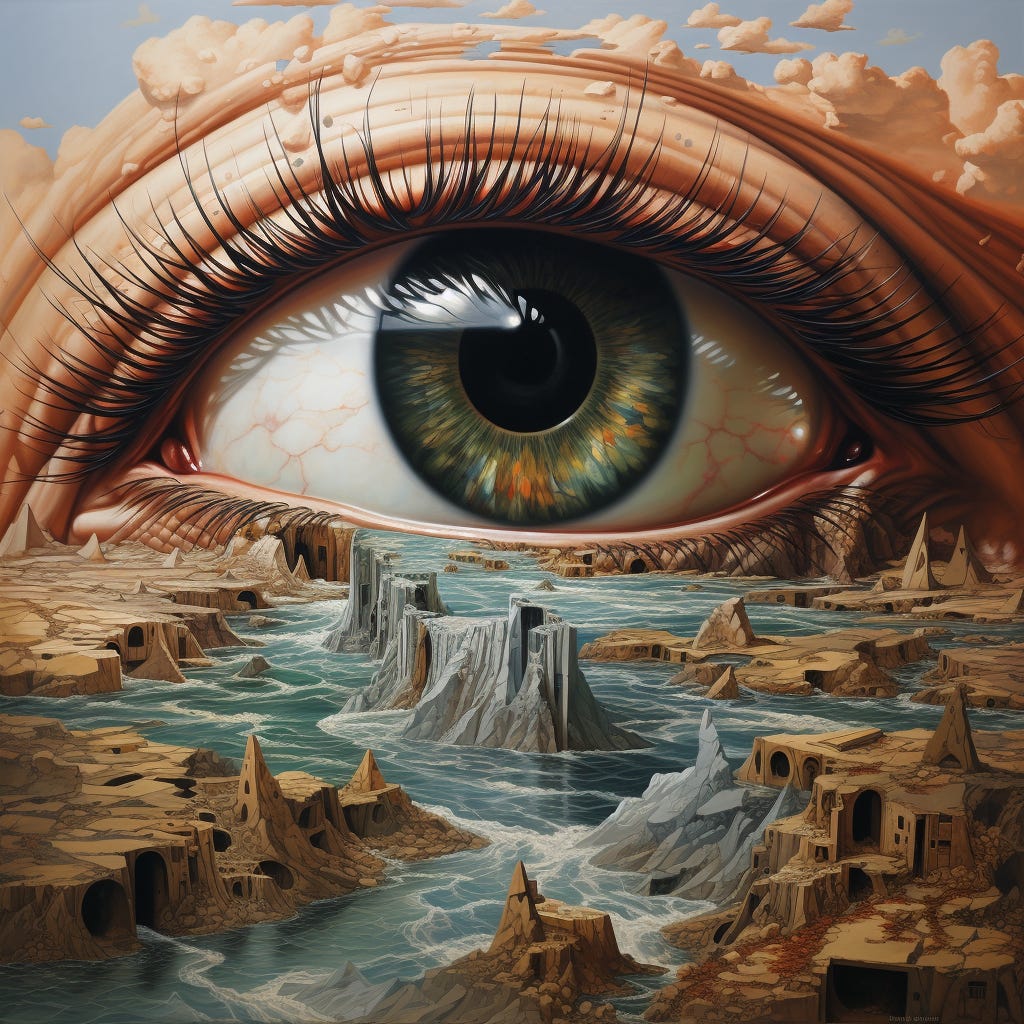
Fundamentals: Ideas and Effects
There are basic concepts from the book Indirect work that you need to bring with you into this reading. I am sketching them here so you can get a sense.
Understanding of ideas: There are 3 levels of engaging with new information in Indirect work. Borrowed ideas - Analysed ideas - Deep understanding. Carol argues that very few get to deeply understand anything. Even Analysed ideas is something that few of us excerpt enough energy to attain. When we come across an idea and cite it, that would be a borrowed idea. She argues that only through careful mapping and being with an idea can we get a true sense of an idea's potential. Differentiation and sitting with the idea hopefully brings us to a deeper, analysed understanding and then to acquire deep understanding we need to practice the idea. Put it to use, let it inform us and permeate the way we think. Simple, right? But not easy.
Outcomes - Results - Effects are three distinctly different things in Carols writing. Outcomes are direct, measurable, easily connected to the inputs. Results are things that come from whatever we are doing but we have to (really) strain to understand the connection between inputs and results. It's something we can imagine, so there is a possibility to grasp that a result would come from the initial action, but it is far from a given that it would come to pass. If that was the result of the action we have successfully applied strategy to get there (or been lucky). Much more so that when we are looking at outcomes. Then there are the effects. Those are the things that we cannot rationally expect. The way to identify effects is by looking back. In looking back we will be able to identify a causal chain, that partially explain the event to a large enough degree. It might feel like the event was determined by the chain of events preceding it that we were able to map. However we need to stay with that all maps are partial. Yet effects as a concept points to the perspective that the past contributes to the present that contributes to the future, but they do not determine another. That means effects are not visible standing at the start of whatever unfolded, there is no way to actually plan or prognos them, instead effects are visible looking back (or perhaps while dreaming).
A brief application: I was listening to Mazzacuto (author of The Value of Everything). She argues that markets are effects. They are consequences of an almost endless number of aspects of how our world is structured. This relates to the obvious stuff like tax law, company law, contract law, and what these were shaped in respons to. It also relates to less obvious stuff like economic paradigm, culture at large. If you look even closer it might also relate to whether some supreme court judge somewhere had a good or a bad lunch before an important case. The story of the market as we look back on it seems linear, as if it made sense and if it was predetermined. In a way it is because it currently has come to be (i.e. a tautology). What a market is not however, is the only way that it could be. Nor is it the only way to achieve a certain effect. What I am saying is: our market is profit driven and focused on money - that is not how it has to be. There has been other markets in other places that worked differently.
This section in two sentences: Understanding something require work, application and practice. Effects are not predictable nor pre-determined nor measurable. Bring these perspectives with you as you keep reading.
4 types of thinking - framework
What Carol Sanford proposes in her book is a framework for orienting our thinking. Here is the original framework in short-form.
There are 4 types of thinking
Thing mind: Focus on the things, the objects, the manifestations in the world
Process mind: Focus on the processes by which things are made. Manufacturing processes, innovation processes, design processes, cultural processes etc. These work on different levels of abstraction
Relational mind: Focus on the relationships that allow for processes to happen. Could be things like the team involved and their relationships or a wider net of relationships like the relationship to the clauses in an employment contract but also more abstract like relationship to status, power, cultural differences etc.
Essence mind: In other theory also called transformative mind. This looks at what underlying patterns we are trying to unfold through whatever we are engaged in. It deals with the inherent energy of whatever it is you are trying to unfold.
Using this framework we can check our own thinking. Sitting with the inquiry in these different levels will allow us to discover what might be hidden by our habitual thinking process. It can become a bit of a checklist if you will or a framework for discovering what is visible yet not (yet) seen. This is exactly what we did in applying this to a design/creation process and the shift really surprised me.
Interlude: How it seems to me most creation processes happen in the world of business.
Before I go on to describe the application of this framework we engaged in I'd want to make a short stop and look at how I perceive most creation to be happening.
I perceive that most creation is done within one thought form. Most commonly thing or process mind. Rarely do we see movement between thought forms in conventional business. And if we do even more rarely is that movement a consciously applied.
I will be radical and claim that even when we apply things like design thinking or other methodologies many practitioners stay in the box of the one or the other thought forms. Or stay stuck on the 'lower levels' of the thought i.e. in thing and process mind. This is usually because when we design most of us do not want to lose our grasp of whatever we are considering. When we move up the ladder to include the relational and essence realms, those are transformative moments. And they come at the cost of rational understanding. That is what I believe creates the main hurdle for them: we cannot get at them directly. The other hurdle is more subtle: if we move towards relational and essence, solutions in my experience has personal consequences. It means we will have to change with the process we are engaged with.
I’m arguing that what we normally do is imagine a thing in the world separated from us. Look at what other people did to build a similar thing and aim to emulate. Sometimes we emulate just the thing, often we emulate the process. Whatever relationships we are coming into the topic with are seen as givens, unevolvable and therefore just part of the background. Or things we have to work around. Yet sometimes, if we do not shift relationships, the thing we are trying to do or get to might not be possible. Very often the thing we imagine, that business we are going to build is there to either get us resources or power so we later can get to work on the real thing.
In that paragraph you can replace thing with app, company, start-up, material, network, service, school, non-profit whatever.
The proposal I have is so simple. So incredibly simple.
I'm proposing that we engage in any creation process as a process of discovery to align all these different thought-forms between and with ourselves, going back and forth between them until there is resonance with all of the aspects of the project we are in. On all levels we can perceive. Only when we see alignment and intuit possibilities to shift all the levels of the system can we begin doing whatever it is we are longing to do.
In my experience that also means that simply bouncing ideas and concepts back and forth will not do. Unless we practice what we are proposing, try our evolving identity on in the real world, no-thing will actually change. I'm proposing something deeply conscious and care-ful. Instead of rushing to be done with it, let us try to make sure that we get it right. Simple right? Yet, that's not easy.
Living life forwards, understanding it backwards - application

So what is it that I am proposing? What did I see when I was playing with this framework? I saw this network of paths unfold from moving in the framework and I saw why I was not fully engaged in the solution that we were exploring. The lack of engagement was telling me that there was misalignment between these forms of thinking. As they aligned, the work got exciting again.
This is how we got into it;
"We need to talk about that... I don't know, it seems like we're stuck, I'm not excited about what we are proposing."
"Why, what's wrong with it?"
"I don’t know. It seems like we are doing what others have already done. And actually it is not something I feel called to engage with. Something’s just off, can’t you feel that?"
"Hmm, yeah I agree. There is something off. But this ... is such a good idea…!".
We took that feeling of “something off” and used it as fuel. It prompted us to deep-dive into where we were. What did we discover? Looking at the brief from the customer we found out that the starting point had limited us. We were trying to do what they told us to do, not do what was needed to move us towards the horizon / vision that we shared with the customer.
We were stuck. In terms of thing mind that is. And then we started mapping. Working our way through our implicit assumptions through the framework.
Process: What was the process we were designing trying to achieve? And then relational: What relationships and materiality was underpinning what we were trying to do? In terms of who we were in the project group as well as our professional identities as well as the relationship to the current paradigm.
All of a sudden we had a map. Our current solution made complete sense. Based on the assumptions we had going in.
What became clear however was that there were other possibilities. So many more posibilites. And more in each layer. The same horizon and the same materiality (relationships, skills, budget etc) revealed many different paths for us in terms of process and each of those paths had many different concepts for programs (in this case). We were free!
Mapping some of the solutions and then getting overwhelmed by the complexity we dropped back. Letting the rational mind take the back seat and instead going by gut feeling. By excitement first and then ease. Putting ourselves in the final stage, imagining the effects that we were hoping to achieve for our client and our program we found another hypothesis. It was as if there was a whole part of the dance floor that we had not even looked at before.
It allowed us to put words to the different underlying theory of change(s) that we were longing for and that came to underpin the decisions we made. Once we had our hypothesis we could check our thinking, rationally moving through it as well as comparing notes with the feasibility work that we had undertaken. There was a sense of relief and excitement around the new hypothesis. As if we were touching upon an energy repository that we had missed before. Enough of it to reveal the next obvious step. The shape of the thing was still the same as was its purpose - yet what is inbetween is subtly and profoundly different. What it took to shift it was to slowly and consciously move ourselves between these different types of thinking.
Questions to consider
Making sense backwards. There it is again. This turns into a 4 step process. First two steps has to do with our givens and identifying where we are. Second two gives us options and creates space to move, it’s a process of (re)imagining with as few fixed variables as possible and engaging more than just our rational mind in the process.
1) Where are we now? What are we assuming that got us here? What is the process parameters we are looking at aiming to achieve? Who does this current solution make us? How does it fit into the current landscape of similar solutions? Where does this type of solution come from? [Focus on what you have taken as givens. Look at where you feel personal resistance. It is a good sign if this gets personal, do not leave anything off the table.]
2) What type of thinking has dominated our current process? [Unfold the thinking back from thing through process, relation and essence. Make a causal map of your process so far that makes sense to you. Explain why you are where you are.] What happens if we relax our givens and focus on the heart of the whatever we are trying to address? How far back do we need to go to feel that initial excitement?
3) What do we need, to follow that excitement forward? Where does that gut feeling take us? How does that path contrast and compare with where we were? What other supporting and contradictory evidence have we uncovered while moving? Have we taken them into account? [What I look for here is joy, ease, energy and clarity. That feeling of “oh, that’s so obvious why didn’t I see it before?”.]
4) Then let's look at this problem again from essence. Let's imagine what the essential effects are that we want to achieve. Let us see if there is a possibility to strip our map of everything but the most necessary. What happens when we are committed (even devoted) only to the essence? Then what becomes possible? Draw the paths you can see - make sense of them. Let ease and obviousness be the heuristic by which you chose path.
Interlude 2: A perspective from the cognitive sciences
What was important in our process were the shifts between perspectives rather than the perspectives themselves. Treating the 4 types of thinking as parallax, and not until we can feel the joy, excitement and ease coming through in all of them will we settle for and start making sense of our approach.
This rhymes well with cognitive science focused on understanding insight. Brain in problem mode is clear, brain with clarity also has a clear pattern but we not yet clear on how we actually transition between the two. It seems that what is important for insight is shifting perspectives. (Perhaps taking a walk or task shifting more conventionally.) Part of what this process does is to embed shifts into our core process.
It also moves us from the clear to the unclear, knowing to not knowing, and the back again. Inviting other forms of knowing or intelligence, letting our emotions be part of it as well as making our-selves (identity) part of the process. Also supported by cognitive science.
To be explicit this oscillating process that we were playing with harvests both our conscious and unconscious. To be able to get at the full potential, requires experimentation. Psychological safety or trust in the team goes without saying. Underlining rhythm/speed as particularly important to consider alongside the content of the process itself. Creating a pace and process where our full intelligence and knowing can get to express itself holds immense potential. A process where personal tension, longing and desire gets interwoven with the entity we are weaving into existence, treating emotions as fuel not as something to avoid. As diverse as possible and still aligned.

Concluding
Key concepts:
Borrowed Ideas - Analysed Ideas - Deep Understanding are three depths of understanding. There is no way to hop, skip and jump to understanding. It requires work and practice.
Results - Outcomes - Effects are three distinct concepts. Effects are what we are usually looking for yet these have to be worked out backwards (and cannot be measured as a direct result of the input).
Thing - Process - Relationship - Essence are the 4 types of thinking that we propose exist. Creating a solid process for you and your team to move through them to find coherence between them will be fruitful.
What I am essentially proposing is to first use the 4 types of thinking unfolding where we are. From the thing back to essence and then take a look at where we would like to be from the other direction from essence to thing. As we move through the framework we need to do that with care, keeping track of our rational, irrational and emotional cues. What we are fundamentally looking for is that element of relaxed surprise, that joy that bubbles through when we find a really simple solution. That’s when it’s time to move. With great attention. Until you are confused again. That confusion is an invitation to revisit this framework and reconnect with the potential. Realigning with it.
Get clear of where you are and what assumptions and realities got you there.
Make a map that explains where you are weaving your way back through the 4 forms of thinking. Look for excitement.
Follow the excitement forward, what if it was possible to do it that way? Repeat. Create several maps.
Simplify. Strip away everything that does not spark joy, ease, excitement, rest, clarity in you. I mean everything. Listen particularly after joyful surprise that feeling of obviousness.
When all thinking forms are aligned, start moving until you get confused again. As you can see none of this is complicated, not at all actually. It’s real simple. Just not easy.