
The next paradigm: From learning to know to Learning to learn - Inquiries into Unlearning
Stop learning to know! The world is heading to a modern initiation that requires unlearning and destabilization. We explore why gambling your identity is the path to lasting embodied change.

This is an inquiry into learning by Amit Paul & Eric Lichtman.

[Amit]: I was recently reminded of James Lovelock’s story, which frames our current moment as the time the planet became self-aware. He identifies the “overview effect”—that picture of Earth from the moon—as the moment when an organism (the planet), having collected enough energy (fossils and otherwise), became aware of itself on a planetary scale. Framing the story this way invites us humans to begin again, reminding us that we live with the planet, not on it. We are in the middle of a paradigm shift of existential proportions. This is driven by shifts in technology, ecology, and human/social systems. It is driving a growing tension in how we fundamentally relate to the world. Any such motion in the past has been accompanied by a learning revolution; we believe that it will this time too. Whatever comes next will transform our capacity to learn.
So, what essentially is learning? I’d argue that it is fundamentally about change. In systems theory, we see learning as distributed. What can one truly learn on one’s own? Change is only real when it is enacted by the system one inhabits. So, when speaking of learning here, we are speaking of the ongoing embodiment of knowledge, an actual change in action and habit—a dynamic ripple throughout the system that does not merely result in regurgitating facts, re-storying, or remaining on the cognitive or idealistic level. Learning has ontological consequences. This is where both learning and unlearning need to happen. Ontological shifts are subtle; suddenly, you realize you are living into a different reality, and reality itself seems to bend in its embrace of changes. At least, that has been my experience over the years.
This takes me to an unexpected point where I know Eric and I have had some tension previously - part of why we ended up writing this piece. The discernment between education and learning. Eric has more ground to stand on here, as his life has been steeped in education, which served as his profession. I’ve made my way through basic schooling with a graduate degree in business. I have little formal training in pedagogy, let alone embodying it with teaching consistency. Yet, transformative forms of learning are real for me, and increasingly available in my presentations, consulting, workshops, and writing. The way I’ve framed education for myself is “to shape.” Education is a cultural project of fitting bodies and minds into what currently is. It may be about learning, but it is not the same as learning. Education lives in the offering and impressing an interpretation of a set of events, highlighting certain significant features. It is more of a formative activity.
It is worth noting that the formal school system is a cultural project of fitting bodies and minds into what currently is. First military then towards a capitalist/Lutheran culture: where productivity and effort is what gives self-value. This narrative is, however, coming under increasing tension - both due generational shifts but also because all the hard work doesn’t seem to be working. We still seem to be headed towards precarious times. There are no longer paths to a working alternative by merely working harder at the existing game. One has to more frequently operate on or outside, at least a few of the edges, to succeed. Instead what we are proposing in this piece is that what learning has to do now is to invite coherence beyond simple convergence. The shift is from learning to know towards learning to learn. That includes meeting diverse perspectives, remaining open, and learning to act from that integrated worldview that contains inconsistencies and diversity.
It feels important to put both the potential and the severity of the topic of learning front and center before we move into it. We will proceed through a series of stories and creative approaches: diverse streams that may, at first, appear to approximate a meandering, contemplative style for the reader. We can look from upstream, downstream, or from being completely immersed ‘in the stream’. Regardless of our positioning, we see important issues that surround learning at this time. Potential benefits can be consequential, especially as we become more aware of how we ‘learn to learn’.
1. Unlearning Old Habits: Illustrative Stories of Mutating Cognition [Eric]
Learning is key. But different learning keys fit into different doorways, creating different openings. Some questions: What happens when former keys, once learned, no longer fit current ‘key-holes’? How do we incorporate “unlearning” into the larger ‘learning cycle,’ and how does it support the whole process? Recent evolutions in the theory of memory and cognition suggest that learning is not a static thing that we retrieve, or call upon; rather, it is a constant, imperfect process of regeneration. Each time it’s recreated, there is potential for a mutation, a gradual shift, or reinterpretation, adapting to context. Some learning is left un-needed and unused, appearing ‘unlearned.’ But the grooves remain, still influencing and informing new tracts of learning.
There’s an episode from my life 20 years ago: I ‘learned’ to drive a hybrid car, which meant gaining greater awareness of fuel efficiency. Though I’d been driving for many years, certain shifts appeared in my habits. For example, I began accelerating more gradually from a stopped position, and began decreasing speeds more gradually when approaching a stoplight. I also noticed how much fuel could be conserved by reducing highway speeds in the US from 65 mph to an average speed limit of 55 mph. My driving skills, learned years before, now became background, while my interests in fuel and energy conservation became foreground.
When new learning is activated and becomes noticeable, what changes in us? What about our sense of identity, including who we think we are? I became a very different driver, less focused on getting somewhere quickly—despite the automobile having the power to do so—and more interested in sacrificing speed to arrive in a relaxed, more energy-efficient way. My ‘driving behavior’ became different from many others’ as a result of the instrumentation in the hybrid that informed my driving.
Learning carries signals beyond the personal self. When one experiences shifts, the surrounding environment does too, because we are related and interdependent. When the surroundings change, and shifts happen, so will we. It’s important to address “learning and unlearning” not only in terms of individual impact, but also how the surroundings themselves impact us and generate change. This points to the mutual flows between collective bodies, and the ongoing, sometimes subtle, interact-ability between ‘us’ and ‘them,’ ‘me’ and ‘other’, and between past and present.
Context matters for learning, similar to how framing influences our perception. Our framing often comes from habit, imitated and learned from many directions, but largely from what we see and experience in our upbringing, culture, class, religion, zeitgeist, and more. Our current technology, attention spans, emotional maturity, and co-regulation capacities—these ingredients can influence what and how we learn, along with the intricate connections and results we like (or dislike) and find ourselves receptive and able to perceive. While much learning comes through repetition, habit and some experimentation, we’re often without conscious awareness of the whole picture, and we don’t fully appreciate the influence of the cycle of learning in which we are engaged.
I was recently taking two urban commuter trains during rush hour in a country foreign to me. Most of the riders were looking at their mobile phones for most of the ride. Eyes glued to small screens; bodies a bit crumpled, heads cast downward, fingers swiping and poking. No matter age, gender, or their standing/sitting positions on the train. Folks seemed to have adjusted as a community, to find comfort being boxed into silos, even though they were practically rubbing shoulders. Unlearning needed here! This probably doesn’t surprise anyone reading this. What do we learn from examining these current habits and postures in view of the various needs for radical changes in not only our personal lives, but more importantly within the larger collective systems in play? The trends from recent decades point toward a much degraded quality of life for decades to come.
Learning is recursive: we learn through our tools and we shape our tools based on that learning, which further shapes our condition and conditioning. There are path dependencies to learning. It’s not possible to learn everything, and we don’t respond the same to every context. Following the mobile phone example, highly influenced by social media, what are we learning from the accumulated minutes spent over time? Granted—we may not completely understand the whole story, the significant shifts, or the lessons until later—when we’re able to take a pause and relax these current compounded habits, which have been carefully engineered to capture our attention and imprison our senses.
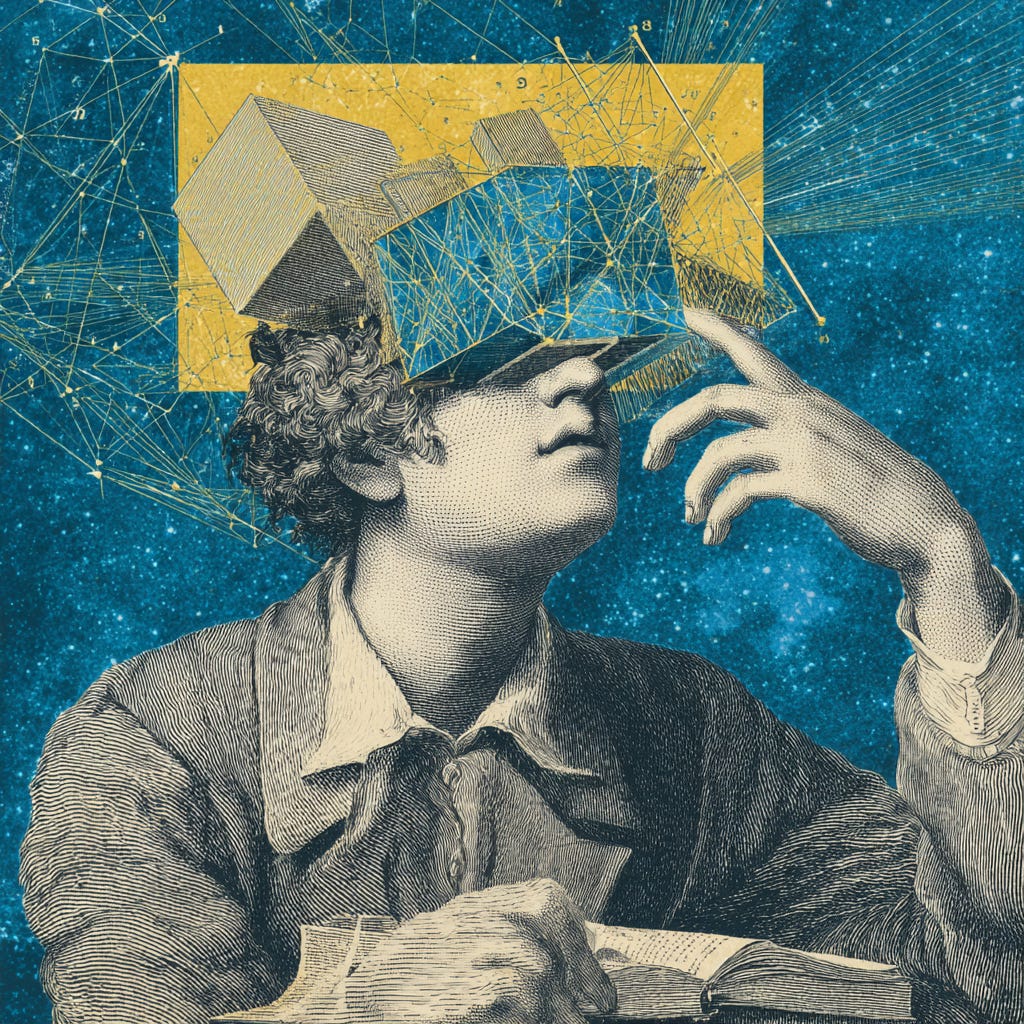
Does our noticing and questioning, as we’re doing now in our excerpt, constitute an important part of learning? Clearly, certain areas of learning will happen with or without our questioning and noticing. It seems to me that significant learning may also occur sideways, when our attention is not monopolized, and we’re not gazing directly at it. As with the hybrid car shift, a change was desired and initiated by me, and then learning simply followed; at times, noticeably—other times, not. Learning begets learning begets learning—enacting a multi-layered process of stimulation and integration. By opening to more spacious perspectives, we find that by increasing space, this makes room for us to notice subtle and incremental changes as they appear.
Let’s take another perspective. The other day, I put in motion a playful experiment, when alone in the kitchen. I tried opening a nearby cabinet, switching up my usual reach by using my left hand. I love inviting into daily life some ‘somatic experiments’ with inquiries that can highlight slight shifts in awareness. By moving into this spontaneous exercise, and attending more carefully to what my left and right hands were in the habit of doing, while preparing breakfast in the kitchen—does this truly qualify as transformational, system-wide learning?
Cognitive science says that this incidental and small somatic engagement, reaching for the kitchen cabinet in a new way, may have created a new coupling that enables another neural pathway, potentially helping to unlock more significant changes in the future. At the time though, I cannot really know where my playful experiment might lead. There’s likely to be a certain amount of unpredictability that comes along with most open-ended learning.
This leads to another example, which draws on my earlier career: Supervisors would judge my performance annually based on the learning strategies they observed in my classrooms. I knew how to ‘spoon-feed’ students so they would perform well on tests and during observations. But this truly was not the kind of learning I emphasized in my pedagogy. I was more interested in ‘pushing the envelope’—creating situations so students and I would learn beyond content and regurgitation. Evaluations of my teaching strategies normally did not concern me, even though they could be somewhat superficial, and ‘checking the boxes’. We all—students, supervisors, teachers— were trapped in cycles where learning serves the institution. I ‘learned’ to exert more care when presenting my teaching strategies to ‘authorities’ at work, especially when my methods could appear radical or unorthodox. My ‘freedom’ to learn about learning, and my incentives to innovate could be compromised by the influence of others—when others or ourselves are judging or evaluating, that can constrain learning possibilities. What radical approaches might we be willing to attempt if we didn’t feel constrained by others and ‘our inner judges’?
When teaching Communication Studies, and introducing complex forms of critical thinking, I would try to challenge students to experiment with new levels of inquiry, often causing frustration; many times they would resist and complain once their old patterns and what they thought they knew were being questioned. Explicitly addressing how these challenges related to the grading requirements opened them up to more experimentation. When higher and open-ended levels of learning are activated, conventional metrics of knowing tend to be less helpful. I have found, over the years, enormous value in studying and teaching from the extensive Time, Space, and Knowledge series, writings that stimulate inquiry-based learning for curious learners to open to knowing and not knowing in penetrating ways. A ‘posture’ of ‘not knowing’ can create subtle shifts of awareness into ‘higher’ levels of learning. We can then allow ‘not knowing’ to be a fresh opening for the unformed, for the ‘not known’ to take form.
This last example I will share involves both a sense of ‘not knowing’, together with a burst of courage and curiosity that generated a significant ‘deep dive’ for me. Two years ago, I had a strong desire for intense group work and selected a program focused on a global “hot spot”—an issue with deep conflicts that brought up active trauma for me and others I knew. This one-year program consisted of 12 monthly online meetings, skillfully facilitated for 35 participants. The goal had not been to ‘solve’ or ‘eliminate’ the hot spots, but to witness and be aware—to be present to the group and to our own experience as much as possible. I experienced foundational changes during the year and was, surprisingly, quite ‘undone’ by the experience. Had I known in advance what the levels of learning and discomfort would be, I certainly would have dodged the program and not joined.
Here’s the point I am making: Even though it was my sincere wish to learn in this group, I could not have anticipated how I would feel at the end—unless I had leaned in and “done the work.” The final session offered participants a wider lens through which we reflected on the past year and it revealed a variety of learning in places I could never have anticipated. These spontaneous learnings became more fully integrated in me. As I reflected, the ripple-effect of the program’s impact were clearly transformational. During the year, the program helped me to create a new template by which I developed the capacity to ‘see through’ trauma within a major global “hot spot.” I experienced the complex roles played by ancestry, history, and religion in new ways. And beyond this, I was able to witness the dynamics of how one’s sense of identity often reinforced the status quo, and reinforced fixed belief systems.
What if the deepest learning currents are like the ocean’s currents? We tend to be mostly aware of the surface changes—the waves and obvious motion. The way these currents create ripples, affecting movements in the depths, may not initially be obvious to us. We layer learning, or better stated, learning layers learning—and it is both dependent and interdependent. Its overall effects may be unpredictable - learning to open cabinets with the other hand, relaxing metrics while teaching or inquiring into our haptic adoption of technology - all creates shifts in ourselves that learning depends on. Disequilibrium becomes an important part of learning. Destabilization is a catalyst that can strengthen one’s willingness to meet life head-on. When we understand this, our hearts engage with our heads, and we become more attuned. We become fully engaged within the depths of our beings - not just merely tracking the surface ripples. So, when intensity appears, which inevitably it will, instead of leaning out, we choose to lean in. With the willingness to expand our capacities, and increase our range of awareness and vulnerability, we also are aligning ourselves to ‘learn to learn’.

Interlude: The Modern Initiation and the Stance of ‘Learning to Learn’ [Amit]
I’m stepping in here for a short reflection. The idea of disequilibrium—and the underlying question of what the learning is for—is pulling me into the text. It seems to me there’s a common thread running from continuous (indigenous) cultures to what our current society is being pushed to realize: What if the meaning of life is learning? Indigenous cultures used initiation—designed hardship—to cultivate their members, imparting learning that went far beyond theoretical transferrence. Often at the risk of death, the young, adolescents, or those meant for higher responsibility would be tested. These tests fundamentally shift one’s world—as anyone who has been through traumatic events or hardship knows: there is a clear before and after.
On a different scale, Eric’s group learning experience shows this: there was no way for him to know what life would be like after the experience. As a result of it, his world changed. The massive technological, ecological, and social shifts we are currently experiencing seem to be offering a similar invitation—a kind of modern initiation. These shifts are robbing us of the future we felt entitled to—one of continuity, production, and extraction. Instead, we are invited to adapt, discover, reevaluate, or perhaps even re-embed. The pressure and speed at which our environment is changing seems to be increasing.
When we shift posture—that is, we move from trying to learn a particular thing that we can ‘do’ towards an awareness of learning to learn—something profound happens. Everything becomes information; all of it becomes stimuli, experimental, and experiential. Non-attachment and a playful, unconditional openness are essential components of the stance that enables this. It’s like dancing with what is, or joyfully walking in the territory, willingly accepting that although there are deeply entrenched path dependencies, a vast wilderness exists for us to move through. This requires us to drop our habits of convenience and comfort. We must still do the work, but we shift our relationship with the word effort—dropping the old story of “no pain, no gain.” This type of moving is significant, and the energy expenditure to learn a different way of walking and being within these changes is considerable. So is the risk: we are putting our entire world at risk, and this is not to be taken lightly. Learning may result in a lasting shift in how we see the world as well as behave in it.
‘Meta-cognition’ is a skill and way to get at such shifts. It is already reflected in ancient wisdom traditions like Hinduism, Buddhism, and Sufism. Meta-cognition has to do with ways of observing your internal thinking process - thinking about how one thinks to help regulate one’s thinking. This capacity can increase our understanding of and resilience to various mental calamities. Various meditative disciplines, some areas of religious practice, and some forms of learning can help one train in meta-cognitive skills. It invites the role of thinking into the process of becoming aware. This awareness has, in my practice, allowed me to see the instabilities of self—the variations and inconsistencies—and taught me to accept them. Meditation, as I understand it, allows me to get closer to what ‘is’ in a relaxed fashion—accepting that my world is neither stable nor linearly progressing. Accepting that fact has in some ways destabilised me; in other ways, it’s opened me up to different ways of being. And that leaning into what we’re calling ‘destabilisation’ has been an important catalyst for increasing my capacity to learn. This is a recurring theme in our writing. So let’s return to our exploration, and Eric will expand on why destabilisation as such may be of service in this shift in the learning we are exploring.
Embracing Destabilization and the Unpredictable Self [Eric]
Why would we invite instability into our lives? I’ve followed some Tibetan teachers who describe the study and practice of teachings attributed to Buddha as placing less emphasis on personal and desirable states like happiness and pleasure. These teachings can lessen the weight of many forms of suffering, but they’re not intended to make our lives completely painless. Rather, when a study and practice like this develops into a spiritual vehicle, it’s designed—in this case—as a challenge to our usual habits: to undo complacency, spotlight the limitations of conventional knowledge, increase awareness, deepen compassion, and heighten wisdom.
By sharing examples of teaching and learning, some quite mundane, we’re highlighting the vital need for us to ‘learn to learn’. This may satisfy our natural appetites for adventure, fresh insights, and surprise. Our thoughts and expectations about learning fulfillment, however, may be quite different from being actually immersed—being “in” the wildness and wilderness of new learning.
In fairness, there are uncontrollable features of “deep learning” that deserve mentioning here: we never really know what eventually we will discover; nor, what we’ll need to embrace when we lean (or fall or leap) into the deep waters of learning. One key ingredient is unpredictability. There are hidden features of learning that evolve largely through emergence and experience. Deep learning seems to emerge through, initially, the momentum of the “old” learner’s wishes and desires. These tend to pull us in and inspire a variety of experiences. Often followed by the “new” learner’s capacity to embrace and integrate the ‘material’, we move through newly-opened doorways, thus inviting the unlocking of fresh experiences. This generates new seeds of curiosity, and exciting cycles of learning. We like to think that the “old” learner and the “new” learner are the same person, the same identity; this sense of continuity to frame learning based on patterns that affirm our identity. We put everything in a single container (me/you) and our identity then becomes a vehicle into which our learning solidifies and is stored. Yet, here’s the rub: the “old” learner may not fully recognize the “new” learner that has emerged.
Without comparing one learning or learner with another, can ‘we’ accept changes as they happen, without self-congratulating and adding confirmation to our sense of success. We can let go of our tendency to cling to a single, primary identity. We can release or loosen our tendency to attach the learning process to ‘someone’ who achieves and ‘someone’ who learns. Maybe by keeping our story-telling and framing wide open without confirming an identity, we ultimately acknowledge the following: ‘We’ essentially are change embodying itself. Change simply merges with what’s happening and ultimately changes us, rather than change becoming something that points to, amounts to... We become less attached to being the ‘doer’ of change. With an enlarged, and more spacious self-description, one wears identity in a loose-fitting way.
To slightly reframe this: in actuality, we’re both energy and light; we’re appearing in momentary form, experiencing this dimension, and being human. When embracing ‘who we are’, moment to moment, we liberate; we’re free to discover the essence of Learning!
2. The Transformative Path of Letting Go: Surrender, Acceptance, and Compassion [Amit]

Dropping ourselves back into the main narrative, our investigation of ways that learning affects our lives, it seems to me that I often encounter conflicting perspectives on learning. One view is that learning is about something entering us—something we are given. Another is that deep learning involves removing something so that we can remember that which we already know. A third view describes it as enabling something—a new movement manifesting through us. The first perspective relates to acquiring a skill, a piece of information, or something to ingest. The second and third relate to something entirely different—something difficult to label. We could argue that the first is ordinary learning, while the second is more akin to unlearning. The third, if repeated over time, would probably shape up toward wisdom or what some may call in-spiration—something invisible (perhaps Source) coming into being or form through us.
There is an assumption that, because the second and third types of learning are more consequential, they would somehow require more effort. In my experience, that is not necessarily so. This assumption is a trap that obscures the ease with which this type of transformative learning may also happen, if only we allow it.
Eric writes about the group that gave him exactly what he asked for, yet perhaps more than he had consciously bargained for, and certainly in a different way than he expected. The journey was something gifted to him; he, in turn, gifted his attention to the program and chose to receive. But to do that, he had to give something up—a being, an identity, a posture, or perhaps an aspect of self.
I used to inhabit a world where I believed I was a stable self—a somewhat coherent, well put-together personality. The project of growth and development was to achieve more stability. In that world, some things were categorized as bad (undesired) and others as good (propelling me in the direction I thought I was going). Naturally, I would try to amplify the good and resist the bad—resist all that life was throwing at me. Hard work! While I am quite familiar with that earlier world, I now live in a ‘living world’ that I ultimately believe is looking out for me. This belief makes possible the cultivation of the capacity to be and remain fully open, responsive, and ‘sense-full.’ Even when hardship comes my way. In this new world, coherence or meaning is something I will discover as a result of that openness; everything is information, and everything is relevant. Information may come as disruption or reinforcement. In practice, the categories of ‘bad’ and ‘good’ are losing their meaning. Instead, I probe what is happening with the question: May this, too, become I?
Let’s ground these esoteric ideas in story.
I began my conscious personal development journey about a decade ago. I entered a new setting and interacted with new people who had no real knowledge of who I was. I had the opportunity to reinvent myself. It was intoxicating; I was free. I experienced, and was convinced, that I had changed. Returning home to my wife, I realized she could not see it. I told her as much, berating her for not trusting that everything was different now. And, with that, I proved her point—that I had not changed. My ability to be different in another context did not seem to have any immediate consequences for those closest to me. Frustrating. This went on for years. I would change, then unchange. I would learn, and then find myself re-enacting earlier habits, as though these were tattoos emblazoned both above and beneath the skin.
It took a long time to develop the capacity to uncover the heart of it—to begin cultivating the muscle of submission, which turned into acceptance, and is now beginning to emerge as self-compassion. The letting go may have even followed the stages of grief: at first there was anger, then I was depressed, at some point I denied that I was unable to change, then I bargained: she’s the only one not getting it, and finally there was acceptance. This progression was full of misplaced effort. Now I see that it was never really about acquiring something, or forcefully fitting into a new frame. Nor was it about trying to acquire traits like non-judgment, non-dual seeing, or non-aggression. It was about letting something go. Letting something move through me. Relaxing. Softening. It was about engaging fully and openly in the ‘metabolic process of coming back into connection with life’ (grief) and accepting that I had kept myself separate for no particular reason at all.
This type of learning seems to have a sinking quality, or so it feels in my body. Sinking from the head toward the heart. Then deeper engaging a full body presence. A beingness where these different ways of knowing dance with one another in a tangled tug-of-love. Interpenetrating unconditional intimacy. It is about reprioritizing attention—from recall to relaxation. It is about respons-ability, presence perhaps, the ability to respond to whatever comes with an open heart.
Another aspect of learning is pace. It seems to happen at a certain rhythm. Learning or transformation loops may be a familiar concept: we find something new (excitement), we dive in with our full attention (work), we meet resistance and are forced to give up (despair or dark night of the soul), and then we break through and begin emerging, not as we thought it would be, but with a new identity. These loops seem to happen at different frequencies for different people. One of my closest collaborators goes through this kind of loop with 3-4 year cycles; this is how it’s always been for him. For me, it’s been a slow, consistent process spanning my life so far. As I began playing with that perspective, it allowed me to embrace the life which is gifted to me. It is all happening for me—so why do I spend energy being in resistance to it? The more curiosity I can cultivate, the more flow becomes accessible to me. But curiosity requires agency in the model of learning we are talking about - it does not live merely in the cognitive. As the agency grows, so does our need for cultivating compassion. Compassion rests on a foundation of responsibility—a willingness to respond even to that which you may perceive isn’t yours. Compassion is what allows us to fail, again and again, and remain open to the learning without hardening ourselves.
Without compassion, there is violence—to self or to those around us. There is convincing, changing, and disharmony. We start, not from where we are, but from where we somehow think we should be. That is when the described reality, as in the example of the school system in the preamble, does not match the lived reality. Instead of learning as a response, we are teaching in ways that are intended to shape the learners into predetermined outcomes or forms. Not meeting them where they are at, which actually just triggers defenses. That is how I think about education, whereas learning in my book has to do with transformation and liberation.
The first step is to start seeing differently. To do that the (un)learning addressed in this chapter is relevant. If we don’t shift our centerpoint, allow for destabilization, and return into a direct relationship with the perennial questions of the meaning of life—the ethos, eros, mythos, logos, and pathos we are longing for—then, there is little to be done. To discover those for ourselves in ways that afford enactment (and enchantment) requires a different kind of learning altogether. It asks us to step into the surrender, acceptance, and compassion loop, with vigor and with rigor.

This is what eventually happened for me: I gave up. I decided there was no way for me to convince my wife. Then I realized that I wasn’t changing for her. I was changing for me. So instead of looking to prove something, or to force behavior into reality, I simply tried to pay attention. I observed what practices and behaviors allowed me to feel better, and I dedicated myself to doing more of those things. After a while, perhaps over six months, my wife mentioned that she was seeing the changes in me; she was feeling the range of transformations that I was beginning to embody. Our conversation began shifting. It led me toward a conversation with my parents, re-molding that relationship also. My friends also began to notice changes in me. This allowed me to shift my professional journey to the one I’m currently on—a path I had never dared to enter. The shift was not so much one of doing, but of stopping the trying. Part of it was unlearning, part of it was to listen to and come into contact with those deeper currents also present in my life. Letting them carry me instead of fighting so hard to control my movement. Coming back into relationship with life, my surroundings, and myself, I realized that there was a conspiracy: it was as if life was working with me, not against me, if I would only let it.
An Important Tool: Inquiry as a Portal to Discovery [Amit]
To go there. To go deeper—we need new tools, new equipment. Vanessa Andreotti and the GTDF collective speak of depth education. Carol Sanford speaks of Socratic inquiry. This is learning that is not about acquiring something from the outside; it is about responding to input and discovering for oneself how that is situated in our body-mind or being.
Inquiry is a set of questions that we can move through. It is a type of framework, but not one that gives us boxes to check. Instead, the questions act as portals for discovery. They are gentle invitations for us to discover for ourselves what blocks us from the knowledge we are currently trying to acquire. If you consider the shape of a question, you’ll notice quickly that it’s a void. It focuses our attention on something that is absent. Removing certainty allows us to experiment with different ways of holding ourselves and moving into unknown territory. The focus lies on enabling the acquisition of something new in the learner; it is less about imparting information and more about caring for how the question shifts the learner. Inquiry is about planting seeds in soil so they may grow.
We uncover the topic or approach through questions. These serve as scaffolds for opening up to it and being with it. We begin to peel back and recognize the different emotional layers that we’ve allowed to cover over a topic. We each get to unfold uniquely, exploring various positions—in relationship—with the topic at hand. There is no one form the learning or conclusion will take. Articulating a question creates a gap—a space that we can move into. Life is inherently space-filling; we can invite more or even ‘the other’ by creating a space. A simple ‘what if’ will tug on our imagination. A ‘how can’ or even ‘can we’ will pull at our creative inclination. ‘Who is…’ will start our relational thinking, and “where could we” will jumpstart our more space-oriented qualities of mind. Any question that will pull in our curiosity or our surprise brings us out of habit and into a conscious process.
3. Conclusion: Learning to Learn, Not Just to Know
This has been a deep inquiry into learning. We have moved through many registers: mundane, almost trivial moments that quietly rewire our circuitry; inquiry-based learning that opens us to ourselves; and learning that transforms us at the core, fundamentally changing how we see and inhabit the world. Every example here is grounded in experience—in things done, not merely thought. The ideas followed the living; the language came last. What remains constant is this: a radical openness, a willingness to be destabilised, and a devotion to following the movement wherever it leads.
We spoke of three forms of learning: the first, where we take in a new piece of information and respond to it. This is the dominating story of learning in our times, where learning is spoken of as something that happens as a result of an idea or prompt. This is what is most prevalent in our education systems, more or less successfully so. But there are other ways of learning too, deeper ways perhaps, or ways that have a different relationship to the architecture of our cognition.
This notion sees an ocean of awareness where new information is merely the crest of a wave on the surface. What this misses are the depths that pull us. Undercurrents and generational structures of meaning direct our attention. Unlearning invites us to swim, conscious of the current beneath the surface; its tug is a result of the landscape or the shape of the shore we are studying. This is not a comfortable undertaking. The self that emerges is rarely the one that went into the currents. The current reveals something different altogether, usually way beyond what we thought it was about. The cost? Transformation.
The third form of learning relates to the deep oceanic currents. Following an evolutionary impulse, it is a deep, intergenerational calling—an invitation to move from intuition or in connection with Source itself. It resembles wisdom when enacted. This access is available to all humans but has been forgotten by many. It feels like emergence or transmission. It avails itself to us through deep listening to the profound rhythms of life.
We speak of learning as an extreme sport for our identity, constantly gambling with it when we engage in this way. When we truly meet the other, the result is that none of us usually escapes unscathed or unmoved. Approaching this with a commitment to responsibility and compassion, with an open heart willing to be moved, takes us into a different domain. This is surrender, or even submission, releasing into a movement and happening bigger than us.
We conclude: learning to learn is a project fundamentally different from learning to know. This posture rests on the capacity to live into the fundamental belief that life happens for us, with us, not to us. This sometimes requires work, a disciplined awareness, and sometimes it happens when we are looking the other way. The entire universe, in this view, is conspiring for us to reclaim the natural movement that only we can hold. Through that diverse movement, life becomes larger; it becomes more. Each person who summons the courage to ask a question and lean into the void it leaves, ‘lives the questions’ in deep devotion to existence—and truly experiences aliveness. This is what learning to learn is.
The portal opens with curiosity and compassion, inviting a learner who leans in and dares to pose this fundamental inquiry with an open heart: What if, this too is I?

Post script: Practices
We provide some exercises as an invitation to dive deeper. To lean in and experience some of the learning for yourself. See if this piece is not merely food for thought but the beginning of a movement. These two exercises are invitations to uncover some of that movement, track it and attune to it. If you have that desire. Enjoy!
First Exercise: The Past
Reflect on several major ‘turning points’ in your life (a significant shift in your reality). Choose one of these on which to focus and explore in depth. What are (or were) ‘the central lessons’ that were being experienced? On reflection, through your engagement during this time, what learning(s) were most useful?
Gather important details from the whole experience now recall;
Highlight any ‘breaking-thru’ moments that appeared—cracks that provided some light, or glimmers of understanding, when seeing thru the build-up ‘of clouds’ that may have formed;
Share how this “turning point” was able to transform your reality, and influence your life.
Has it become integrated in the larger dance(s) of your life and your view of Learning Adventures? Please describe briefly.
Suggestions of some elements to consider:
How did allowing space—maybe the surrounding outer and inner spaces—assist in the Turning Point appearing and transforming?
How did ingredients like time, emotions, confusion, conflict, ‘not knowing’, past patterns, other people, etc, add to the pressures and intensity you were experiencing?
What fresh messages came through during this period? What understanding, or wisdom, appeared that helped the process of ‘Breaking Through’? Reflecting now, did subtle knowing or ‘not knowing’ moments play into the ‘shifts’ in your reality? (Note: we tend to dismiss subtle cues or ‘whispers of knowing’ that often accompany inner sensing.)
Appreciate various points of learning when reviewing “Turning Point”. Feel into how it’s now appearing in the ‘present’. In a curious way—it can be ongoing, and alive, still happening when in the ‘fresh present’.
Second Exercise: The Future
Imagine that—[say, in 5 - 10 - 20 - 30 or 40 years from now—you pick!] amazing possibilities exist for living your life more ‘fully’, however you define ‘fully’. Encourage ‘future sensing’ and invite ‘time-travel’ forward in this exercise:
How is this future time period appearing now? How envisioning? What’s arising? Any visuals, sounds, tastes, smells, movements, thoughts in future, impressions, etc?
In your imagination, does your ‘future sensing’ lead to an expansive caring for others and the world? Or, is what you’re sensing now more pulled in, contracted, and perhaps more boxed in and survival oriented?
Imagine, if you will—taking the expansive version first— dynamic and radiant energies are activated, distributed throughout, with points of light streaming.
Continuing with this version—Invite your luminosity, highlighting your energies, skills and special talents. Sense into images and sensations that bring this future to be very alive in you now.
If, however, your ‘Imaginal Future’ version has a darker and more contracted feel, play with the edges offered in this version; lightly feel into its nature, ingredients, substance, and directionality; explore your learning and ‘unlearning’ in this future version
Suggestions:
Choose one of the above future versions— or maybe explore a composite of both— and imagine finding specific keys that smoothly unlock important doors.
Describe, as best you can, any of these keys, and the pathways that are opening.
Also, describe any specific lessons that may become available when considering these future scenarios.
As these doors or gateways to the future are open, remember to loosen all images of self identity as they appear. Again, travel, journey through these open doors.
Eyes, ears, hearts open wide instantly. What insights appear? Is this appearing to be more a personal or collective future? (or both?)—Please explain.
Keep feeding and sensing into this future as it appears, ‘at the edge of time’; continue to invite whatever appears to come alive in you. Appreciate how realities have the capacity to ‘shift and bend’.
Now take time to invite your creative nature to play: Describe, Draw, Dance, Make Music, Move, Create, Feel—maybe it’s with music, food preparing & menus, architecture & designing, art forms, ways of shaping, creative writing, etc?—Feed these impressions into your envisioned future. Experience what emerges. Put learning into action.
Also, continue to release or loosen whatever familiar ‘self identities’ arise. Not your usual you’s! (Stretch/Expand your notions. Consider: “What if, this too is I?”)
Any Extremes experienced? These incidents may seem ridiculous, wild, weird, or strange (even if uncomfortable or exciting?). What surprises—what kinds of learning—and Unlearning—are appearing as you explore this exercise?
Note: Your willingness to try out / try on—any form of the above exercises— reflects a kind of ‘daring yourself’ to explore —“learning to learn.” We’d be curious to learn what you discover!